Weeknote #24: Patterns
I'm attempting to write this at the tail end of a very full on week involving team away days, a museum visit, board meetings, and an exhibition opening. Fun, challenging but also exhausting. It's becoming easier to bash out these notes, but I probably need to find time to do some deeper thinking on a couple of topics.
What happened this week?
It was great to welcome our new Head of Engagement, Peggy Hughes, to the Library, although I fear she had a busier week than me! She has a nice instagram full of books and outdoor goodness.
Tuesday saw me head west for a Scotland Committee meeting with the Heritage Fund in Paisley Town Hall. It's a total privilege to assess a wide-range of funding bids - from inspirational local place-making initiatives through to nationally significant projects. This was followed by a nice reception and team meal at the Glasgow Art Club.
The next day focussed on a visit to Paisley Museum. Project director, Kirsty Devine, set out the story-led approach at the heart of both interpretation and design decisions. I was struck by the team's openness to new approaches and letting go of certainty and control through the storytelling process. As the renowned museum consultant Eliane Heumann Gurain has said, being "world class" is "a competition with an unseen other" and should never be an aim in itself. Kirsty instead spoke about the goal to build confidence and pride within the community and establishing a new narrative for a place once dubbed "the tumbleweed town".
Since a very dusty and noisy visit back in 2024, the museum is now feeling calm, clean and ready for install. I loved the numerous design patterns incorporating the 'warp' and 'weft' of the weaving process and was finally convinced by the red "drum" entrance. Sadly, no pictures were allowed.
Wednesday involved Board and Leadership workshops aiming to identify the key priorities and opportunities for the Library over the next years. We started off the day with a Manual of Me exercise, which is often the easiest way to talk about communication/working styles, as well as reveal some more personal details. Within the leadership team there are two dominant personality "types", but it feels like the right mix across our very broad remits.
Later in the day it was good to hear directly from the Scottish Government on what Public Sector Reform might mean for the National cultural bodies over the course of the next parliament. There were some reassuring messages, but there is work to do to make the case for why we matter and what is at risk without sustained investment.
The day was topped off with the launch event for the Library's new exhibition, Rain. The weather outside lived up to expectations and I loved the mix of books, objects, maps and poetry reflecting the varied nature of our collections.
Friday was a Library Board meeting. As ever, some robust challenge on the choices we are making, but good understanding on the overall operational constraints. Our Chair is pushing us more to be take a few more risks and be braver when we can identify gaps or opportunities.
Lots of catching up on Friday afternoon and trying to squeeze in meetings for the week ahead. There's a funding bid being considered but we might have to let it go due to limited capacity and a very tight turn around.
Surveying AI
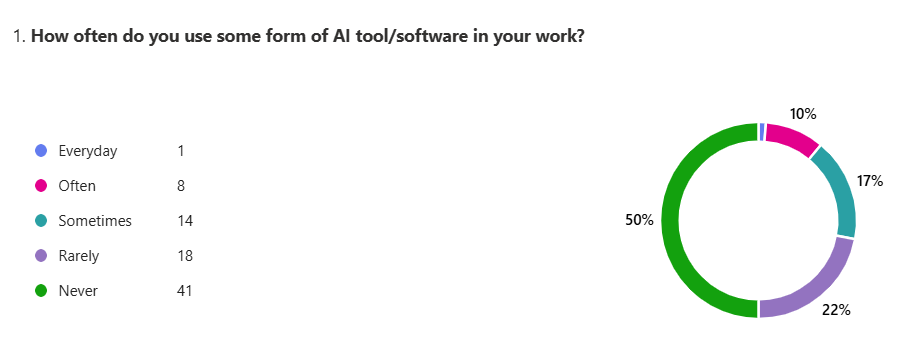
We've had almost 100 submissions to our staff AI survey. So far, we're seeing a broad range of usage and some patterns emerging from the responses. The majority of staff are not using, or just 'viewing', AI tools in their work. I've shared some early findings with a couple of orgs and hope they will run similar survey over the Summer.
This piece by Kristen Darrow was helpful to think about leadership engagement and clarity in how organisations consider AI, including recognising the human emotional element of AI encounters.
The latest Harvard Business Review usage report (How people are really using AI in 2026) has some good insights on general uptake and rising scepticism: "As the breadth and depth of usage grows, so has the anxiety that people are surrendering their cognitive responsibilities to AI."
The Integration Problem, flagged by John Fitzgerald, warns against falling into the "faster horses trap" with AI, especially in contexts where staff are often holding everything together by hand: "The reason to put an agent to work [is] to take the carrying off people, so that more of them, and more of their attention, goes to the thing the charity exists for."
A couple of AI-focussed articles on my reading list:
- AI is slowing down just as it needs to speed up by Ed Zitron
- The World has moved on by Corrie Doctorow
Interesting things
- I often refer to Tom Loosemore's longstanding definition of digital - and did so again at the Library Board Meeting this week. It's a helpful way to point beyond technology as the sole driver of change and consider the conditions in which technology is used - crucially, to meet the people's raised expectations. Ten years later, the rise of AI and rapid pace of chnage might require a new definition. Whilst the internet as we know it is changing beneath us (with bots now outnumbering humans), it remains the basis for most digital work and cultural sector orgs are still struggling with building secure, foundational services and implementing user-centred ways of working. So, I'm yet to be convinced by Tom's options to define this rapidly-shifting era ("Ai", "Agentic", "Intelligence"), but he's spot on about the need for organisations to develop high situational awareness, be mindful of sovereignty and become highly adaptive. People love a definition and there were interesting comments on Tom's LinkedIn post.
- Mechanical Pencil: Another beautifully-designed site exploring how everyday stuff works (h/t Ash Mann). This is the kind of thing I would love to see more of on digital labels within exhibitions.