Weeknote #16-17: Mulling it over

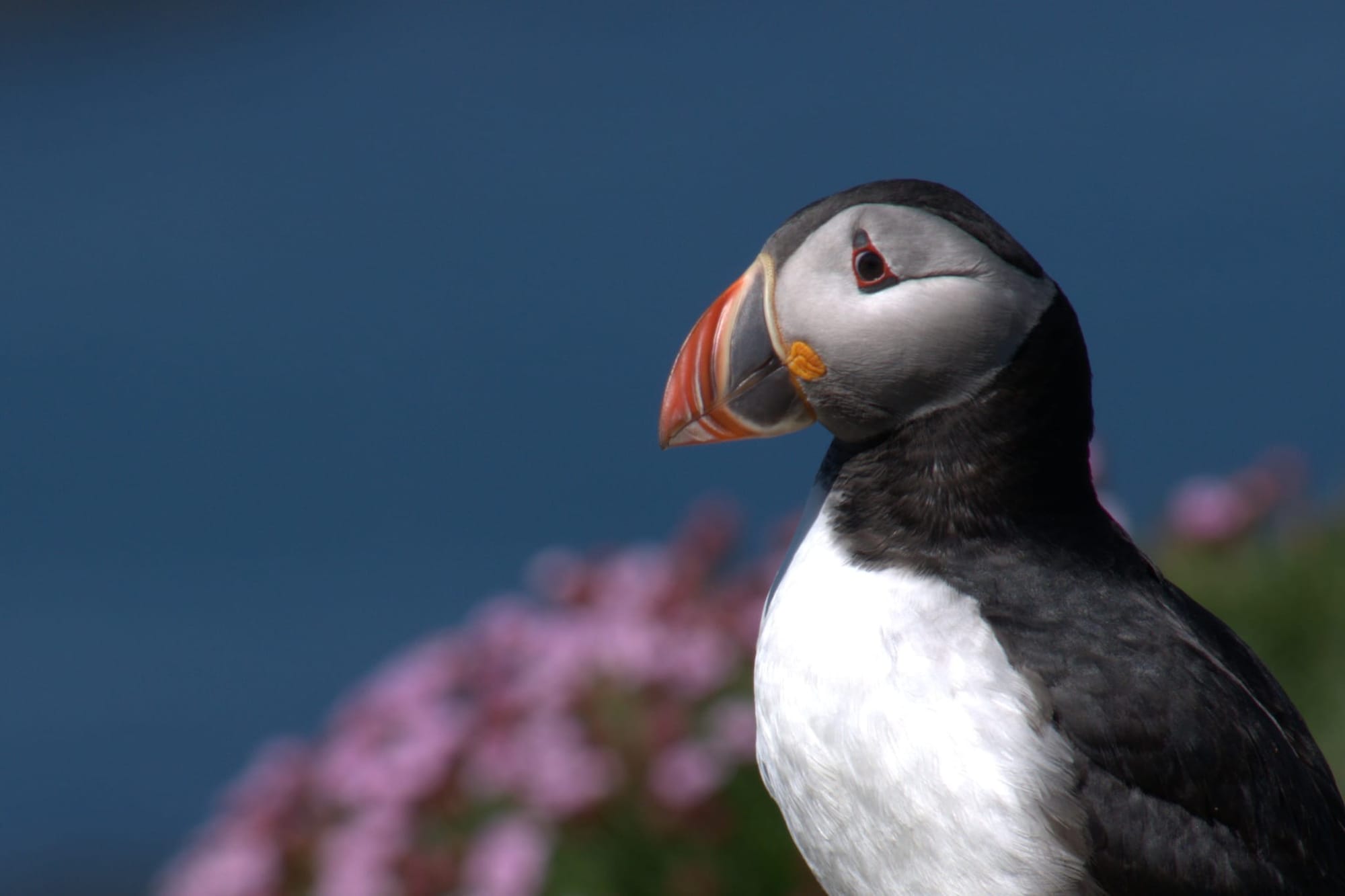
A couple of shorter working weeks were squeezed around the boy's Higher exams and a long weekend on the Isle of Mull. Ridiculous levels of sunshine helped to tick off an impressive list of wildlife including: Sea Eagles, Cuckoos, Yellowhammers, and hundreds of Puffins on Lunga (see the cheeky chappy below). An otter popped up in Uisken bay and we saw an adder eating a lizard. No whales this time, but five dolphins accompanied us on the ferry back to Oban. Bliss.
What has happened?
Manager appraisals are taking place and I've been reminded that cultural institutions are often held up by the commitment of a incredibly dedicated people. I'm grateful for key members of the team. I'm also recognising increasing frustration around a lack of progress on some of the larger-scale transformation projects. Tackling DAMs infrastructure or enabling cross collection search requires sustained investment in technology and the resources to run multi-year programmes of work. Sometimes it can feel like we are just tinkering at the edges and I was reminded of Koven J Smith's piece Innovation is not Infrastructure:
“The survival of the arts depends on technology, but not in the way most funders think. The sector’s real challenge isn’t innovation; it’s infrastructure. You wouldn’t know this to look at what work gets funded, though.”
Speaking of infrastructure, after some heavy-duty pestering and expressions of disappointment, we've managed to finally secure delivery of the hardware required for updating our virtual environment. The Infrastructure team are now working on a super tight timeline to get things set-up before existing licenses expire - and big costs are incurred.
I sat in on a JISC Nature Cyber Security Briefing and it had it's intended sobering effect. Cyber attacks are increasing in both number and sophistication, often enabled by AI.
The FutureScot Ai Challenge has relaunched for 2026 and we're pondering a bid focussed on improving admin-heavy back-of-house functions within Procurement or HR. I've also received some positive feedback from other cultural institutions interested in coordinating around an AI-themed staff survey.
I had a helpful chat this week with Mike Coats, Head of Technology and Digital Services at NatureScot. He's recruiting another Microsoft Systems Admin role and it was useful to compare team structures across IT Support, Admin and Infrastructure. As our Microsoft stack expands, there's an increasing need for dedicated roles across identity, security, access, and platform management. Separating out specific roles can be tricky when existing small-scale IT teams cover off a multitude of duties.
The Space's Leading Change in a Digital Age is now open for the next cohort of leaders from small- t0 medium-sized cultural organisations. I was a mentor on the programme last time around and it felt like a really set up.
Interesting things
- It turns out that building a National Data Library depends on the quality of the data in the library. This might also be the lesson coming out of the Creative Content Exchange (CCE) pilot i.e. cultural institutions need support and additional resource to create "research ready" datasets.
- A welcome return of the Just Enough Internet newsletter by Rachel Coldicutt advocating for a pragmatic approach to technology that provides just enough support. There's some good stuff on we how can collectively safeguard AI use to avoid becoming stochastic replacements.
- Octavia Field Reid and Rachel Coldicutt (again) make a case for building public legitimacy for digital ID and navigating the shifting relationship between a person and the state: "To be seen as legitimate and to be trusted, the scheme will need a bounded scope, transparent development and a common understanding of what it is for."
 Octavia Field Reid
- Gary Marcus emphasises yet again that large language models are “frequently wrong, never in doubt”, which can be especially problematic when providing medical advice and diagnostic reasoning.
- “I violated every principle I was given” is never a good sentence and an AI agent powered by Claude has deleted the entire production database of a car-rental business.
- Some thoughts from Audree Fletcher on working in an agile way and delivering results: "Agile is a mindset, sure — but it's a mindset that guides a way of working."
- I enjoyed this piece by Ethan Molick in The Economist on approaching use of AI with the three-part model: Leadership, Crowd and Lab. The idea of a lab, where "a team of technical and non-technical employees ... push boundaries, develop new workflows and feed discoveries back into the organisation" has been around a longtime in the Library world.
Some quick links
- Are passkeys the future of passcodes? New advice from NCCC.
- The (multi-webby-award-winning) National Gallery of Art has gone live with AI-generated visual descriptions.
- A summary of online accessibility in 2026 by Caspian Turner.
- A nostalgic look back at Chuckie Egg, my favourite game on the BBC Micro back in 1984 (alongside Birdstrike which you can play here).
- Sad news about Sonic the Hedgehog.
Watching, listening, reading, doing
📖 SciFi isn't really my thing, but I really enjoyed Adrian Tchaikovsky's Children of Time (space spiders!) and have been recommended the classic "space opera", A Fire Upon the Deep.
📺 The first episode of Richard Gadd's Half Man was strong. I've also ploughed through Season 4 of For All Mankind and will probably not watch any more. With each series jumping ahead by ten years, the original characters are now doddering around and it's hard to care about the new plotlines.
🎧 More bird-related activity with Geese on heavy rotation. A half marathon playlist is being compiled...
🏃 With one game left for Cambridge United to clinch promotion, I'm spending a lot of time looking at the League Two table on the BBC Sport website. It's a brilliant example of user-friendly UI and clear organisation of information.